
Here’s to a great 2012! I hope you all had a safe and Happy New Year.

Here’s to a great 2012! I hope you all had a safe and Happy New Year.
Constructed in 1869 using big limestone blocks, the Chicago Water Tower, with all its small neo-gothic towers resembles more a tiny European medieval castle than a water tower. It was designed by architect William W. Boyington and houses a 40 meter standpipe which was used to equalize the pressure of the water pumped from the adjacent pumping station. The tower reaches a height of 154 ft or 47 meter and towered over all the neighboring buildings. Today it is dwarfed by the many skyscrapers surrounding the tower.

Since its survival of the Great Fire, the Water Tower became one of the city’s most famous icons as it symbolized Chicago’s resilience. It was threatened with demolition several times – in 1906, 1918 and 1948 – but it was saved each time thanks to a public outcry. The tower was eventually restored in 1962. In May of 1969, during the year of its centennial anniversary, the Chicago Water Tower was selected by the American Water Works Association to be the first American Water Landmark.
Today the tower is one of the most important historic attractions in Chicago. It houses a gallery which showcases works from local photographers.
Preston Bradley Hall is located at the Chicago Cultural Center downtown. This is where you can find the famous Louis Comfort Tiffany stained glass dome. This dome was restored in 2008 with amazing results to allow the dome to be viewed as it was in 1897. Approximately 38 feet in diameter, the dome spans more than 1,000 square feet. It contains some 30,000 pieces of glass in 243 sections held within an ornate cast iron frame.

To view more information on the restoration of the dome, click here.

This photo was taken in Preston Bradley Hall at the Chicago Cultural Center. It was taken out of the East-facing window out onto Michigan Ave. with the reflection of Preston Bradley Hall.

Taken from Level 7 of Water Tower Place during the after Christmas shopping rush in downtown Chicago.
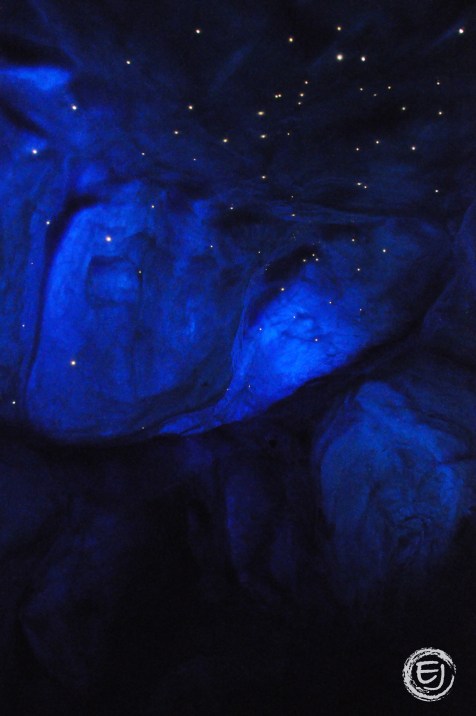
When you visit the Shedd and head underground to view the Polar Play Zone, there are plastic replicas of an iceberg from under the water that children can walk through. Inside the iceberg are plastic fish you can find and little lights inside. I captured this that reminds me of the Blue Cosmos in space.

My sister is in town from San Diego for Christmas and brought her dog Charlie with her. I caught this shot of him lying around on the couch all festive in his Santa hat and thought it was a perfect end to a wonderful Christmas.
Merry Christmas!

This is a photo of Santa on the Santa Clause Express Holiday CTA Train in Chicago..
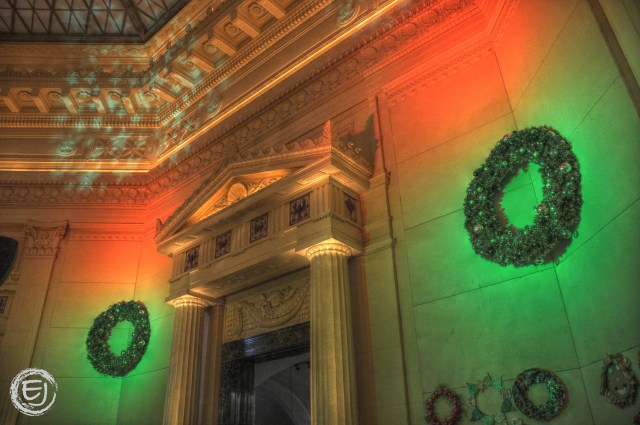
The Shedd decorated for the holidays. Wreaths along the walls with a light display in red, green and a hint of stars.
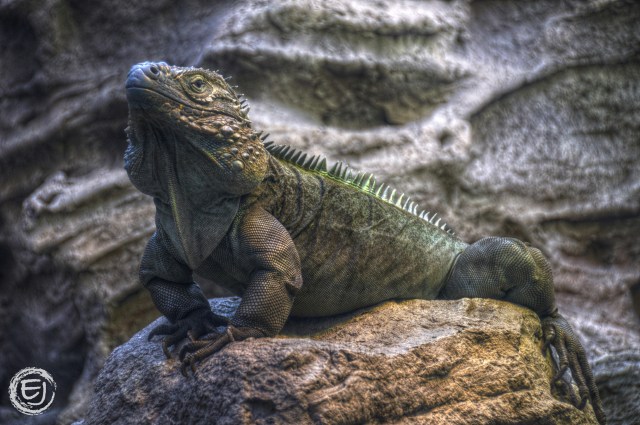
A part of the Waters of the World exhibit at the Shedd Aquarium, this is the Blue Iguana, A 2002 report issued by the National Trust for the Cayman Islands said fewer than 30 Grand Cayman blue iguanas (Cyclura lewisi) remained in the wild. Fewer than 120 existed globally when you added those living at zoos, aquariums and conservation centers. Without intervention, the report said, the blue iguana would be functionally extinct by 2007. Let’s put on our boots and start marching.
The blue iguana is found only on Grand Cayman, a tiny, rocky island in the British West Indies. It can grow to
5 feet long and eats a vegetarian menu of leaves, flowers and fruit. During the mating season, hormones turn the males electric blue while the females brighten to powder blue.
Preferring a solitary life, females will ferociously defend fixed territories while males tend to casually roam around or bask. The pace quickens in spring, when males chase or battle one another over females. Once a female is fertilized, she will burrow until she finds the perfect conditions for building a nest, then ram her way back out and disguise the nest with soil and debris. Each juvenile arduously opens its shell over a prolonged period. Once all the hatchlings are out of their shells and have regained their strength, they thrust through the soil in a single line and scatter into the undergrowth.
Predation by cats and dogs and habitat loss are among the blue iguanas’ biggest killers. Shedd Aquarium is one of 10 U.S. institutions trying to breed these vanishing iguanas, supporting the blue iguana recovery program on Grand Cayman, which is now restoring captive- reared young blue iguanas to the wild in protected areas. Long off exhibit, our pair, Marley and Eleanor, moved into a new 1,200-square-foot rocky habitat in Waters of the World in 2005. Not only do visitors have a closer view than in the wild, but learning about them is a powerful means to help prevent their extinction.



You might remember seeing this lightning photo from my "Day 181: Lightning Strikes" post. It was chosen to be the main screen in the Gameday Central App.

To find more great Cubs items, click here.
 Showcasing Chicago One Image at a Time